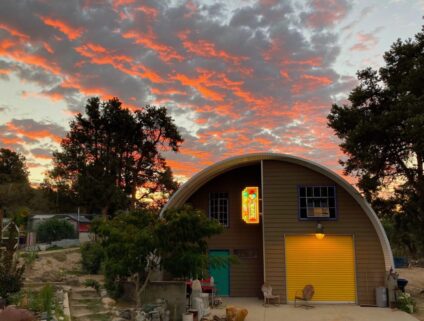
Building on the Yukon: Andy & Denise’s Alaska Metal Building
Andy Bassich and Denise Becker live on a remote stretch of the Yukon River in Alaska, over an hour from the nearest community of Eagle. Known to viewers of Life Below Zero, they handle off-grid living every day, including building a secure, durable workshop for their homestead.
Life Below Zero differentiates itself from other reality survival shows by treating remoteness as the central antagonist rather than just a backdrop. The series follows subsistence residents living in the “dead zones” of the Alaskan bush, often hundreds of miles from the nearest road, doctor, or grocery store.
The narrative tension relies entirely on the lack of a safety net. For example, a broken snowmobile part or a missed shot during a hunt is not just an inconvenience; it can be a life-threatening crisis because help is inaccessible. The show emphasizes that in isolation, time and resources are finite, and the cast must solve complex mechanical and physiological problems entirely on their own to survive the winter.
Andy’s Remote Building (& Bear-Proofing) Needs
Being located in the remote wilderness of Alaska, with the closest town of Eagle being an hour away, the list of buildings that would work was short.
For Andy, the building had to meet three key needs:
- Easy transportation: The entire building kit needed to ship in a compact load that he could move onto his property without special equipment or oversized-hauling restrictions.
- Manageable assembly with his own equipment: He wanted something he could put together using what he already had on-site, rather than renting lifts or bringing in a full crew.
- Bear-proof security: The structure had to stand up to wildlife pressure, so durable steel and a fully enclosed design gave him confidence that his gear would stay protected.
After researching different types of buildings, Andy determined that a Quonset hut checked all of these boxes.
“The ability to transport it on boats, on pallets that were sizes that I could operate with the equipment I had, and then the fact that it would be a really secure bear-proof building in the end were the main things that had to fit my criteria.”
Assembling Their Remote Home Storage
Andy started the assembly on his own. “The first three arches I put up basically took two days,” he said. He later had a friend help him with the remaining sixteen arches, which also went up in just two days.
Denise helped keep the process organized and held the nuts and bolts while Andy tightened them.
“Everything fit perfectly, and we quickly found a rhythm,” Denise said.
“There were no glitches. It was just a matter of being very mechanical, methodical, going up, moving the ladder, climbing, and coming back down to the next one.”
Once the arches were in place, Andy says putting up the end walls was fast. “There was a bit of a learning curve, but once I figured that out, putting up the endwalls was super quick and easy,” Andy said.
A Durable Solution for Off-Grid Living
Now complete, the building provides the secure, practical storage they needed in the Alaskan wilderness.
Even after 10 inches of snow covered the structure, it is holding up perfectly and protecting the tractor that they’ve stored inside. Andy plans to insulate the building in the spring for temperature control.
“All in all, I’ve been really happy with the product.”
For anyone taking on off-grid construction in Alaska, steel Quonset huts offer a reliable, easy-to-assemble solution even in the most remote locations.
Related articles
Maximizing Space with Shipping Container Storage Units
The Wishing Well Center: Community Builds Quonset Hut for Non-Profit
Crafting the Ultimate Workshop with a SteelMaster Quonset Hut
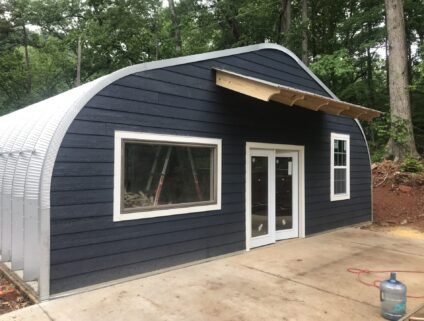
Crafting Creative Spaces with SteelMaster Buildings
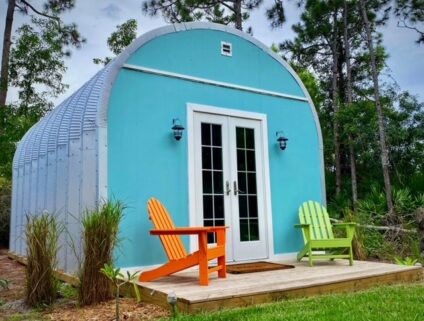
SteelMaster Customer Transforms S-Model Shed into Backyard Gym
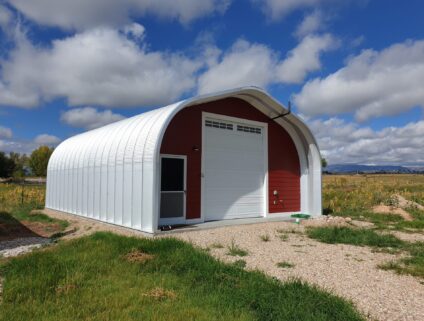
From Quonset Hut to Dream Retreat: A SteelMaster Customer’s Journey
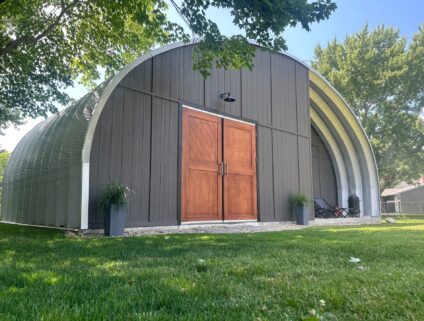
Bending Wood and Metal: The Artistry of a Quonset Hut Woodworking Workshop
The Curved Canvas: SteelMaster Customer Designs Dream Studio
Man Builds Quonset Hut Workshop With Repurposed Materials