

Understanding the Anatomy of a Quonset
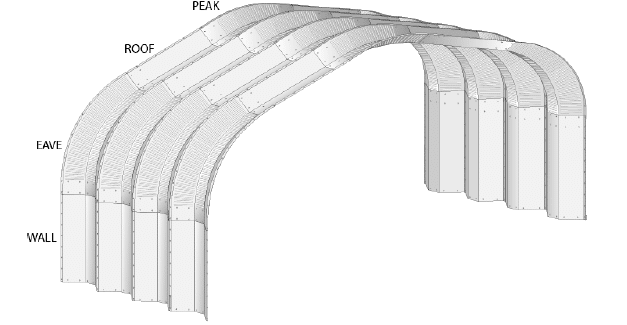
Quonset huts are comprised of arch panels bolted together to form steel arches, which are then bolted together to form pre-engineered structures designed to withstand snow, wind, and the test of time. Each part of the arch and the hardware connecting them is foundational to a Quonset’s superior strength compared to traditional buildings.
Understanding these components and their contributions to a building’s overall durability can help you determine if a Quonset will meet your needs. The components of a Quonset include:
- Peak
- Roof
- Eave
- Wall
- Hardware (nuts, bolts, washers)
The Peak: Strength Starts Here
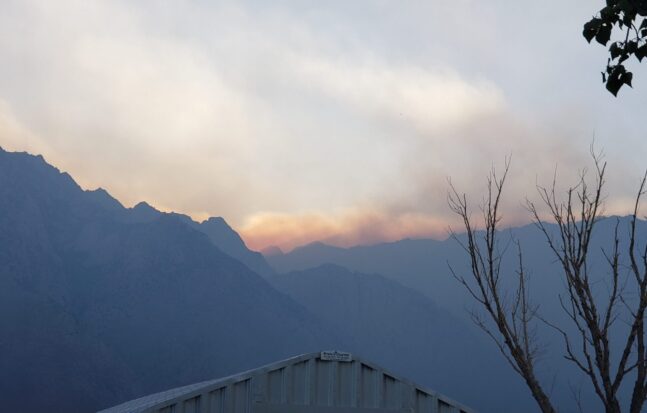
The peak is the highest point of the arch where both sides of the curve meet. There are two types of panels to choose from, each with a slightly different peak. Type I panels have a wider curve at the peak, while Type II panels are a little smaller and have a steeper arch.
Rounded Peak (Type I):
- Smooth continuous curve
- Best for shedding snow
- Strongest for wide spans
Steeper Peak (Type II):
- Provides a bit more interior height
- More traditional roof appearance
- Useful for workshops or vehicle lifts
Both types use the same overlapping panel system to lock the shape in place. Neither is automatically “stronger” and both can be engineered for heavy snow, wind, or large widths. In most cases, the choice comes down to interior height and the look you want.
How it contributes to structural strength: The steeper peak of a Type II arch channels loads more directly into the sidewalls, helping reduce bending at the top under heavy snow or other vertical loads. This geometry increases stiffness along the top of the building, improving the shell’s resistance to deflection and local buckling. While outward thrust is reduced, it is still present and managed by sidewall anchoring.
The Roof: Support for Your Space
In an arch-style structure, the roof is not just a cover; it is the structure itself. Unlike traditional beam and truss buildings, where a heavy roof sits on top of separate walls, the arch forms a continuous, self-supporting shell. This geometry distributes weight evenly along the curve, making the building highly resistant to heavy snow, hurricane-force winds, and other extreme loads.
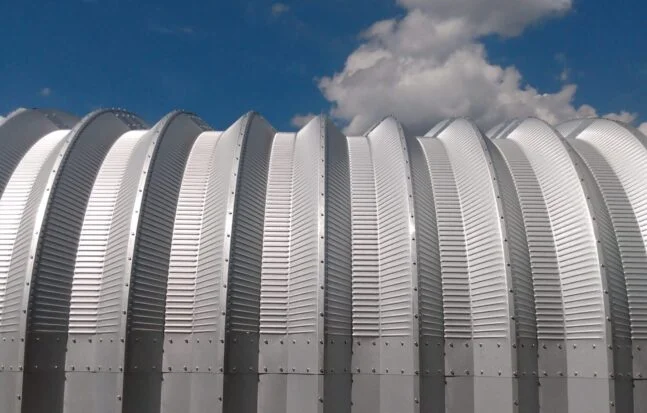
The design of the roof panels is as important as the steel gauge:
- Unified Load Distribution: Because the roof panels curve seamlessly into the sidewalls, weight and pressure are transferred efficiently to the foundation rather than concentrating on a single point.
- Weatherproof Integrity: The deep, overlapping panel system forms a tight seal, keeping out rain, snow, and debris while adding rigidity to the arch.
- Corrosion Resistance: Galvalume Plus coating and heavy-duty steel connections protect the panels from rust, ensuring decades of structural integrity.
Together with the eaves and peak, the roof panels form a cohesive shell that provides long-term durability. While the peak shape, Type I or Type II, changes the profile, the fundamental strength of the roof panels is consistent across all models.
How it contributes to structural strength: Deep corrugations act like rigid beams, increasing stiffness so thin steel can support heavy loads without bending. Bolted panels act as a single structural diaphragm, transferring wind and seismic forces across the shell and preventing individual panels from shearing or buckling.
The Eave: Real Buildings Have Curves
On a traditional building, the eave is a sharp 90-degree joint where the roof hangs over the wall. This creates a weak spot for leaks, wind uplift, and structural separation. In an arch building, the eave is a continuous, robust structural curve, where the roof transitions into the sidewall.
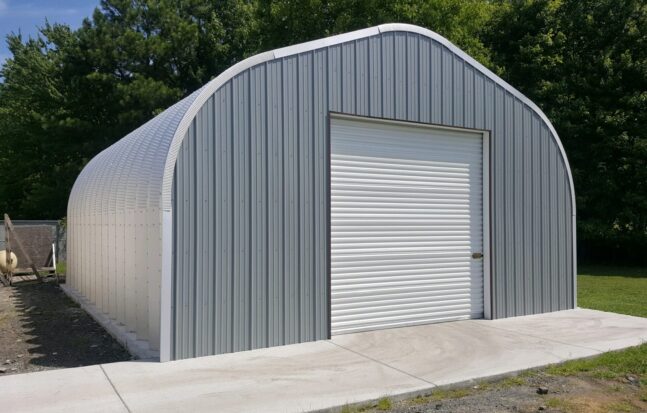
This curved transition offers several advantages over traditional straight eaves:
- Aerodynamic Superiority: Traditional eaves can trap wind and create uplift forces that damage roofs or the structure. The curved arch allows wind to flow smoothly over the building without finding a lip to grab onto.
- Self-Cleaning Geometry: There are no flat spots for ice dams or clogged gutters. Snow and water naturally shed from the continuous curve.
- Zero-Maintenance Joint: Traditional eaves require flashing, soffits, and fascia that can rot or decay. The arch eave is solid, curved steel that needs no maintenance.
The overlapping panels continue through the eave without interruption, creating a weather-tight surface that adds to the overall stability of the building.
How it contributes to structural strength: The curved eave forms a rigid moment connection rather than a pinned joint. In traditional framing, the point where the roof truss rests on the wall acts as a hinge, requiring extra bracing to prevent the walls from spreading outward. The continuous arch eliminates this hinge, converting outward thrust into vertical compression. This allows the building to carry heavy vertical loads, such as snow, without walls bowing outward and without the need for internal columns or cross-ties.
The Wall: Maximizing Space and Stability
The wall panels play a bigger role in the performance and usability of an arch building than most people realize. While the peak, roof, and curved eaves give the building its iconic look, the walls are the workhorses that transfer all loads to the foundation. Quonset-style building walls generally fall into two categories: angled sidewalls and straight sidewalls.
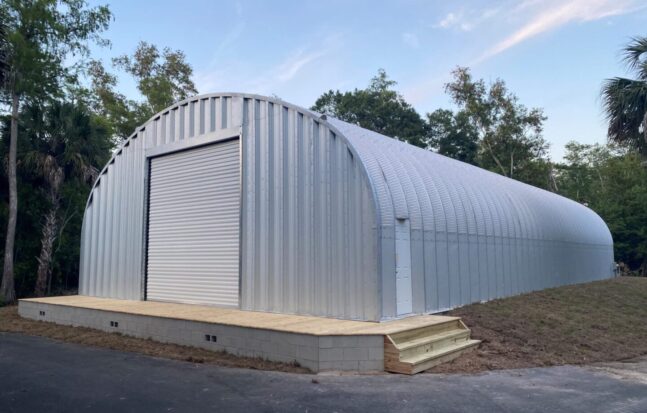
Angled Sidewalls (Model Q & Model X)
- Maximum Efficiency: The continuous arch shape is one of the strongest geometric forms for spanning wide distances.
- Weather Deflection: The aerodynamic profile sheds rain, wind, and snow, so nothing builds up against the side.
- Structural Purity: Loads are distributed evenly along the entire arch.
Straight Sidewalls (Model S & Model A)
- Usable Volume: Vertical height at the edges allows vehicles to park or pallets to be stacked right up to the wall.
- Traditional Utility: Standard commercial doors, windows, and shelving can be installed easily.
- Hybrid Strength: Combines the practicality of straight walls with the clear-span efficiency of an arch roof.
Straight sidewalls provide more traditional interior proportions without compromising the overall integrity of the steel shell. As with the peak, choosing a wall style depends on aesthetics and the local building code or structural requirements. In most cases, either option works, but in extreme weather or larger buildings, angled sidewalls can offer extra structural benefits.
How it contributes to structural strength: In angled sidewall models, the wall acts primarily in compression, channeling loads directly into the foundation with minimal bending stress. This makes the structure highly resistant to heavy snow or the building’s own weight. In straight sidewall models, the corrugated steel acts like hundreds of steel studs working together, giving the walls a high resistance to buckling. The folded geometry supports massive vertical roof loads while maintaining overall integrity.
The Hardware: Small Nuts & Bolts, Big Impact
The building’s hardware may seem minor, but it is the linchpin of a Quonset hut’s structural integrity. Unlike typical metal buildings that rely on welds or self-tapping screws, an arch-style building gains its rigidity from thousands of high-grade, zinc-plated bolts and nuts. This hardware forms an interconnected network that ensures decades of durability.
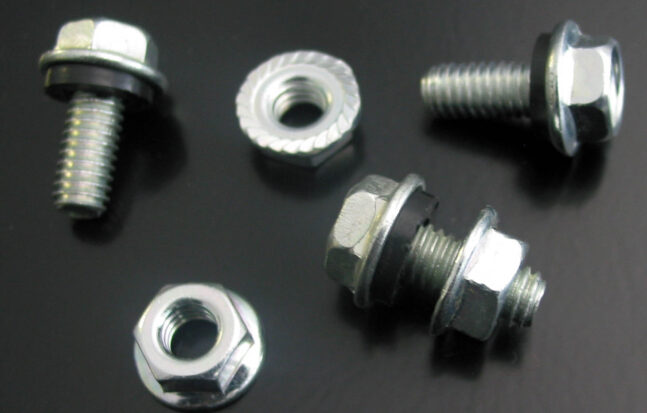
- Grade 2 or Higher Strength: Every seam is secured with heavy-duty bolts designed to handle significant shear and tension forces, far outperforming the screws used in pole barns or rigid-frame buildings.
- Diaphragm Creation: When torqued to specification, the bolts lock individual panels together into a single, continuous diaphragm that behaves as one unified sheet of steel.
- Vibration Resistance: Self-locking or serrated flange nuts grip the steel, keeping connections tight under wind vibration, thermal expansion, and contraction.
Every bolt acts as a reinforcement point. By mechanically locking the panels together, the hardware transforms a stack of steel sheets into a self-supporting structure capable of withstanding extreme loads.
How it contributes to structural strength: The bolted connections provide shear transfer and moment continuity. Wind hitting the side of the building tries to slide the panels past each other. The staggered, double-row bolt pattern prevents this sliding, forcing the panels to work together. Tight connections also allow bending forces from heavy roof loads to be shared across the entire arch, ensuring that snow or other vertical loads are supported by the full structure rather than by individual panels alone.
Your Quonset Questions Answered
Do I need to apply sealant or caulk between the panels to keep water out?
Sealant or caulk is not required between the panels. When properly assembled, the structural design handles weatherproofing for you. The panels overlap, typically by 9 inches or more, so water runs over the ribs and down to the ground without seeping inside.
If the bolts loosen over time due to wind vibration, will the building lose strength?
The hardware system is designed to prevent this. The kits include serrated flanges or self-locking nuts. When tightened to the correct torque, the serrations grip the steel, keeping the connections secure against vibration, thermal expansion, and contraction. We recommend a visual inspection annually as part of good property maintenance.
Can I insulate the interior or hang lights without damaging the structural shell?
Yes. The deep corrugations that provide structural strength also create convenient mounting points. You can attach insulation pins, framing for spray foam, or brackets for lights and conduit directly to the bolts or panel ribs. The steel shell is robust enough to support standard interior loads without affecting its ability to handle snow or wind. In addition to corrugation, the steel gauge can be adjusted based on your expected loads, providing extra stiffness and support where needed.
If the arch shape provides the strength, why does steel gauge matter?
The arch shape directs forces, and the steel gauge provides the capacity to handle them. Thicker steel (lower gauge numbers) is needed in areas with high snow loads to prevent buckling. Our engineering team selects the appropriate gauge based on local building codes and weather requirements to ensure the shell remains strong under all conditions.
Is the steeper "Type II" peak always better than the rounded "Type I" peak?
Not necessarily. The Type II peak offers slightly higher resistance to vertical loads, but the Type I rounded peak is also extremely strong and can withstand hurricane-force winds. For most customers, the choice comes down to aesthetic preference or interior height needs.